

TeraNet Projects | Optical Ground Stations
Leading the deployment of Laser Communications
High-speed, secure data transmission powered by advanced optical technologies.

Connecting Earth and Space Through Western Australia’s Optical Network
TeraNet’s optical ground stations are transforming space communication by delivering high-speed, secure, and reliable data transfer between Earth, low Earth orbit, and beyond.
Located in Western Australia, these stations harness cutting-edge free-space optical communication technologies to overcome the limitations of traditional radio frequency systems.
With a focus on ultra-high data rates, low latency, and quantum-secured communications, TeraNet is setting a new standard for global connectivity and interplanetary exploration.

Key Features of TeraNet’s Optical Ground Stations
High-Speed Data Transmission:
Achieving data rates exceeding 100 Gbps, enabling faster and more efficient communication for space missions.
Quantum-Ready Security:
Equipped for quantum communication protocols, ensuring next-generation data encryption and protection.
Advanced Adaptive Optics:
Mitigating atmospheric interference for precise and reliable communication links, even in challenging conditions.
Global and Interplanetary Reach:
Supporting integration with satellite constellations, deep-space missions, and global communication networks.
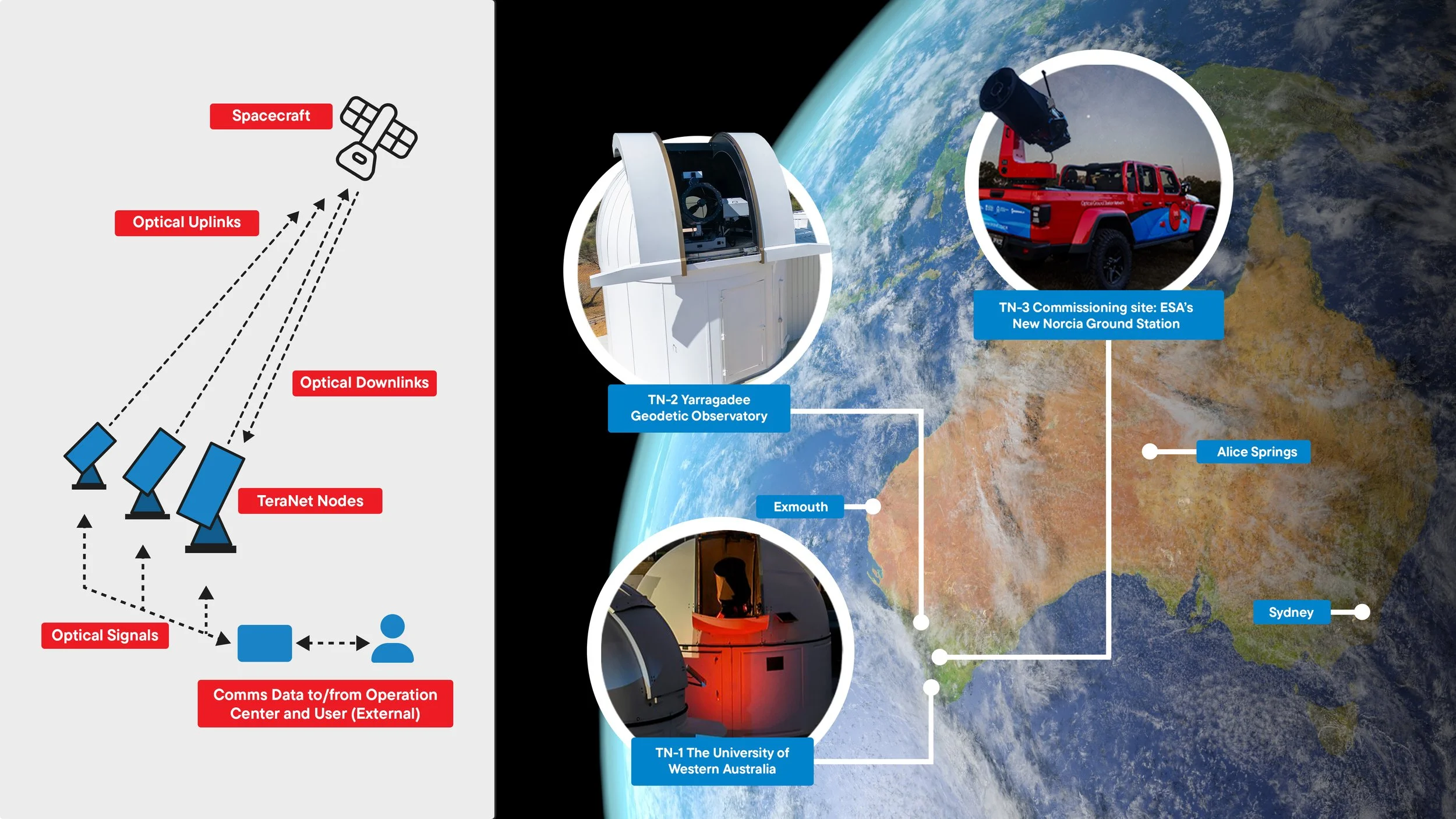
The TeraNet Optical Ground Station Network
The network comprises three innovative nodes strategically located in Western Australia.
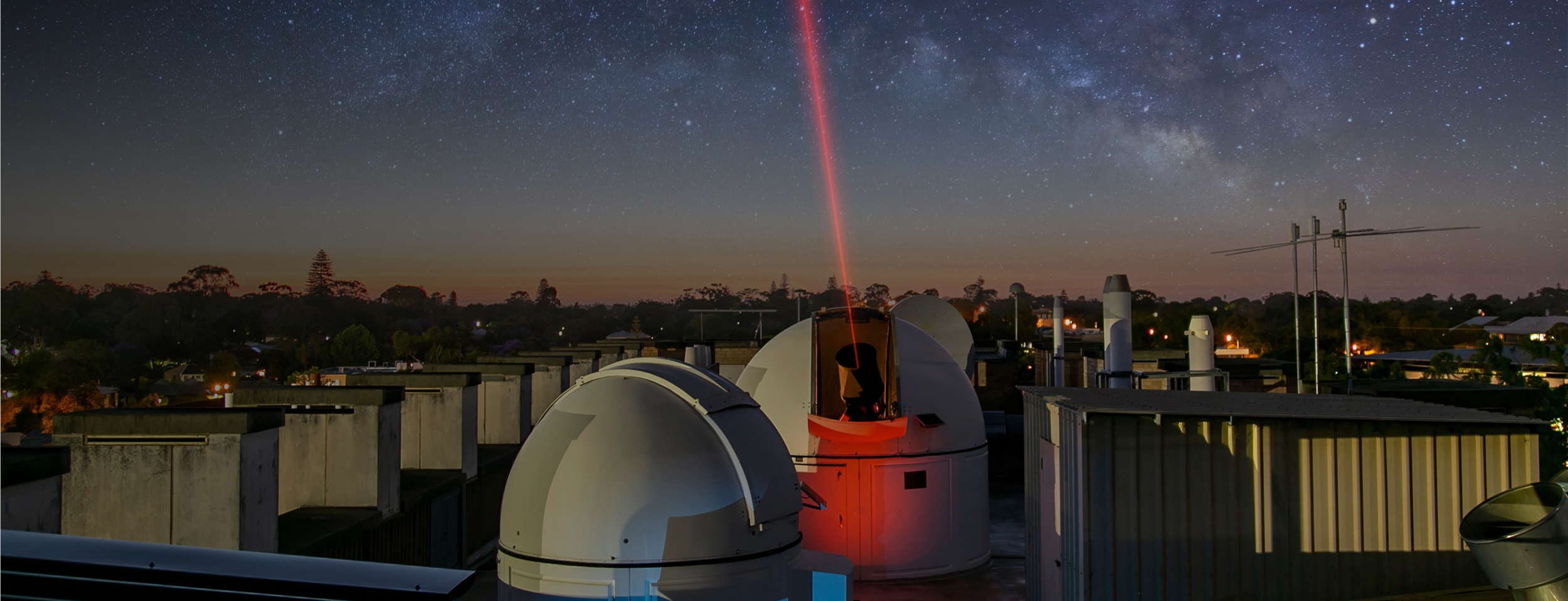
TeraNet-1 (TN-1): Perth
Situated at the heart of UWA, this fully automated 70cm optical ground station serves as the cornerstone for TeraNet’s innovative communication network.
As a hub for advanced research, prototyping, and, and data transmission, TN-1 plays a critical role in the development and deployment of cutting-edge optical communication technologies. Its strategic location within UWA ensures rapid integration of new hardware, making it an ideal site for initial testing and experimentation in rfee-space optical communication.
-
University of Western Australia
-31.97878, 115.81674 -
Sirius Observatory 3.5m telescope dome
-
PlaneWave Instruments CDK700
Aperture = 70cm -
Tip-tilt first order adaptive optics.
-
Fundamental Communications
Optical on off keying, CCSDS 141/142 compliant (SDA upgradable).
Advanced communications
Deep space communications compatible, using existing high photon efficiency pulse modulation system and superconducting nanowire single-photon detectors.
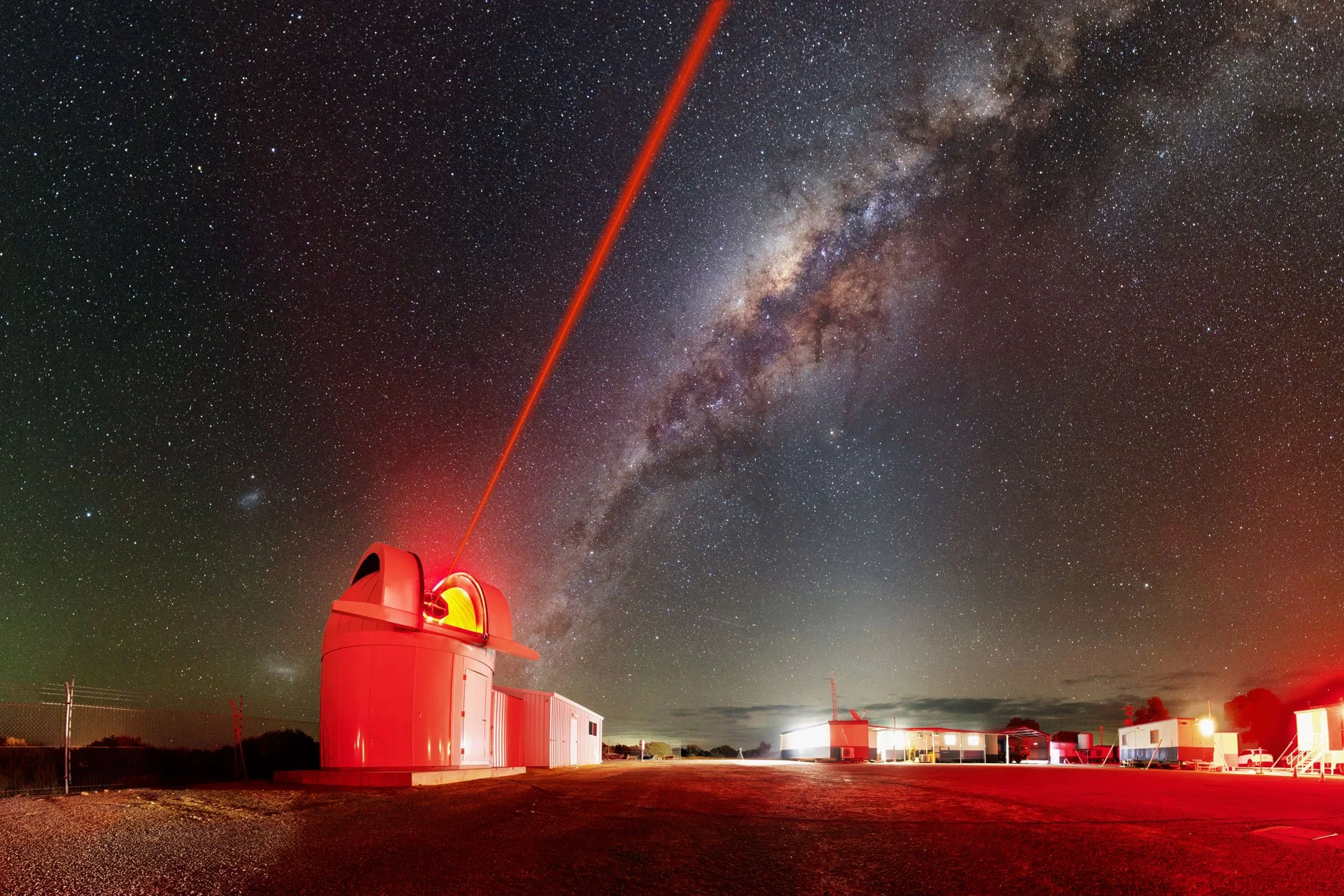
TeraNet-2 (TN-2): Yarragadee Geodetic Observatory
Currently under development, this 70cm optical ground station is equipped with advanced adaptive optics.
Co-located with NASA’s MOBLAS-5 Satellite Laser Ranging Facility and numerous private and national satellite communication facilities, TN-2 benefits from an ideal location with exceptionally low cloud cover, a no-fly zone, and access to a redundant high-speed optical fibre network, ensuring robust and reliable optical communication operations.
-
Yarragadee Geodetic Observatory
-29.04683, 115.34674 -
4.6m Gambato Dome
-
PlaneWave Instruments RC700
Aperture = 70cm -
Tip-tilt first order adaptive optics
HartSCI's ClearStar AO higher-order adaptive optics. -
Fundamental Communications
Optical on off keying, CCSDS 141/142 compliant (SDA upgradable).
Advanced communications
Coherent communications compatible, using existing DCO module. Quantum communications compatible, using existing high-efficiency single-mode fibre coupling system and photonic phase stabilisation system. Coherent timing and position compatible, using existing high-efficiency single-mode fibre coupling system and photonic phase stabilisation system.

TeraNet-3 (TN-3): Mobile Node
A fully mobile 43cm optical ground station mounted on a Jeep Gladiator, offering unparalleled versatility for optical communication operations.
This compact and self-contained system does not require external power, hydraulic jacks, or levelling systems, enabling rapid deployment in diverse and remote environments.
Designed for efficiency, TN-3 is operational in under 10 minutes, even during daylight, making it an invaluable asset for dynamic and real-time connectivity.
-
A fully mobile and was be initially located at ESA New Norcia Deep Space Ground Station -31.04791, 116.1932
-
Jeep Gladiator
-
PlaneWave Instruments CDK14 with L-500 mount
Aperture=43cm -
Tip-tilt first order adaptive optics.
-
Fundamental Communications
Optical on off keying, CCSDS 141/142 compliant (SDA upgradable).

Why Optical Ground Stations Are the Future
-
Revolutionising data transmission by addressing the growing demand for secure, high-capacity communication technologies.
-
Developing solutions like quantum-secured links and adaptive optics to overcome the limitations of radio frequency systems.
-
Partnering with leading space agencies, academic institutions, and commercial stakeholders to achieve its ambitious goals.
-
Advanced encryption ensures secure data transmission against modern threats.

Looking Ahead
TeraNet’s optical ground stations are laying the foundation for a global optical mesh network, designed to integrate with advanced communication systems worldwide.
These innovations are essential for the future of interplanetary exploration and quantum-secured data transmission, making Western Australia a leader in space communication technologies
